







This item qualifies for an interest-free payment plan. This exclusive feature is made available to customers who would like to pay off qualified purchases in installments. Learn More
Free expedited shipping is available on this item. Allow 3-5 business days for delivery to the U.S.A. and Canada. Allow 5-10 business days for international deliveries. Express shipping may be available at checkout. Minor shipping delays may occur. All items are carefully packaged to ensure safe arrival. We ship Monday to Thursday. Learn more
| CIVILIZATION | Roman |
| PERIOD | Roman Imperial |
| DATE | circa 1st-2nd Century A.D. |
| MATERIAL | Bronze |
| MOUNTED | Yes |
Roman Bronze Figure of Mercury
Roman Imperial, circa 1st-2nd Century A.D.

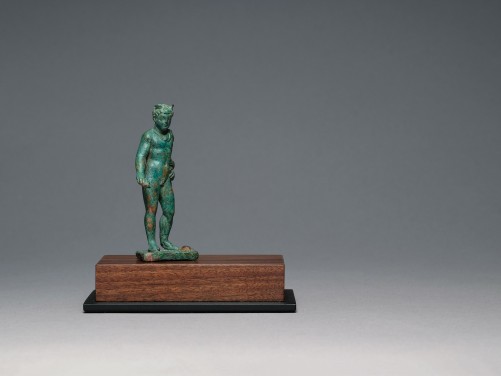
The small intricately detailed figure depicts the messenger god Mercury, nude except for the chlamys fastened on his right shoulder and draped at his back, with its lower edge wrapped around his left lower arm, the youthful divinity stands with his weight on his right leg and his left leg bent, set on a low plinth.
The pose, in which the left hip is dropped somewhat and the right hip pushed up, displays a graceful S-curve that is more noticeable seen from the back. Mercury holds his right arm slightly down and away from his body, the hand grasping a small moneybag; the left arm is more sharply bent, with the hand placed against that hip, probably holding a caduceus.
The god holds his head slightly down and to his right side, his wide-open almond-shaped eyes giving him a somewhat pensive expression. A pair of wings emerges from his short curly hair, enabling him to fly swiftly.
Mercury was the protector of travelers and merchants and, judging by the large number of extant bronze figures, was among the most popular deities in the Late Hellenistic to Roman Imperial periods. Althoug
The small intricately detailed figure depicts the messenger god Mercury, nude except for the chlamys fastened on his right shoulder and draped at his back, with its lower edge wrapped around his left lower arm, the youthful divinity stands with his weight on his right leg and his left leg bent, set on a low plinth.
The pose, in which the left hip is dropped somewhat and the right hip pushed up, displays a graceful S-curve that is more noticeable seen from the back. Mercury holds his right arm slightly down and away from his body, the hand grasping a small moneybag; the left arm is more sharply bent, with the hand placed against that hip, probably holding a caduceus.
The god holds his head slightly down and to his right side, his wide-open almond-shaped eyes giving him a somewhat pensive expression. A pair of wings emerges from his short curly hair, enabling him to fly swiftly.
Mercury was the protector of travelers and merchants and, judging by the large number of extant bronze figures, was among the most popular deities in the Late Hellenistic to Roman Imperial periods. Although there was a preference for poses generally reminiscent of Polykleitan types, such as the Doryphoros, the statuettes exhibit great variety.
Very fine example with a beautiful green patina. The proportions are excellent, the form and curves make for a desirable example. Overall, a small masterpiece.
Formerly in the Content collection, New York and London, 1980s.
Medusa Ancient Art collection, Canada, acquired from the above, 2010.
Beck, Bol, & Bückling, eds. Polyklet: Der Bildhauer der griechischen Klassik (exhibition catalogue, Frankfurt, Liebghaus) (Mainz, 1990), p. 398, fig. 238, no. 15, for a close parallel.
Walters Art Museum, inv. 54.1482, for a parallel.
Berlin, inv. Misc. 7093, for a parallel.
Princeton, inv. Y1956-96, for a parallel.
Information available upon request
This item qualifies for an interest-free payment plan. This exclusive feature is made available to customers who would like to pay off qualified purchases in installments. Learn More
Free expedited shipping is available on this item. Allow 3-5 business days for delivery to the U.S.A. and Canada. Allow 5-10 business days for international deliveries. Express shipping may be available at checkout. Minor shipping delays may occur. All items are carefully packaged to ensure safe arrival. We ship Monday to Thursday. Learn more
| CATEGORY | Roman |
| PERIOD | Roman Imperial |
| DATE | circa 1st-2nd Century A.D. |
| MATERIAL | |
| MOUNTED | Yes |




